Frequently Asked Questions
Who this product is for?
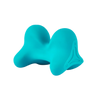
Triaid is designed to be used by anyone, in any situation. The key use of the Triaid is to act as a self-massage tool for those who suffer from upper cervical pain and tension, or cervical tension-type headaches as it's main design feature allows the device to trigger point the suboccipital region at the base of the skull. The relatively small size of the triaid allows you to carry it with you in a sports/gym bag, travel bag or handbag.
Is Tri-Aid safe for everyone?
For most healthy adults, yes. Tri-Aid is a self-massage tool, which means you are always in control of how much pressure goes in, and that is the main safety feature. Start gently, build up slowly, and let comfort be your guide rather than pushing for intensity.
Getting the pressure right
Start with light pressure for around 30 seconds on a spot, and build up over a few sessions as you get used to how it feels.
You are aiming for firm, releasing pressure that you can breathe through. If you are bracing, holding your breath or gritting your teeth, you have gone too far.
Do not stay on any one spot for more than 90 seconds, and keep to two or three sessions a day.
Give an area at least a day before working it hard again.
Positioning
For the neck and the base of the skull, lie down on the floor or a firm bed rather than standing against a wall. Lying down gives you far more control over how much of your body weight goes through the device.
Keep the pressure on muscle rather than bone, and ease off around joints, the bumps of the spine and the edges of the shoulder blades.
Afterwards
Mild tenderness for a day or so is normal, in the same way it is after a deep tissue massage. Bruising, sharp pain, or tenderness that is still building the next day means you were pressing too hard, so ease right off next time.
If you are new to trigger point work, or you are not sure whether Tri-Aid is right for your situation, have a chat with your GP, physio, chiro or myotherapist first.
What is the return policy?
The Triaid can be returned within 15 days of receiving the product with no questions asked as long as it is in a new condition. Please refer to our returns policy for more details or go directly to our return portal.
What is the Tri-Aid made of?
The Tri-Aid unit is made from 100% recyclable Silicon and the packaging is made from 100% recycled paper pulp.
How is it different from other ‘massage balls’ on the market?
The Triaid is a unique design with the primary function of allowing users to self trigger point the upper cervical neck and self manage their cervical tension type headaches.
The multi-point device allows users to carry a complete self massage tool in their day to day bag, as the Triaid combines a trigger point ball, peanut ball, foam roller and hand held trigger point device into one unit.
Can Tri-Aid help with neck tension and tension headaches?
Many of our customers use Tri-Aid when neck tension builds up, including the kind of tension that can contribute to headaches. It works by letting you apply targeted pressure to the suboccipital muscles at the base of the skull. If your headaches are frequent, severe or new, please see your GP or a qualified practitioner.
Can Tri-Aid be used to treat myofascial trigger points?
Yes. The three-sided design lets you apply pressure to tight spots across the body, from the upper traps and thoracic spine through to the glutes and hip flexors.
Will the Tri-Aid fit in my back pack or sportsbag?
Yes! Our small and compact design means you can take your Tri-Aid everywhere!
Can I travel on a plane with the Tri-Aid?
Yes! The Tri-Aid is 100% fly friendly.
Does the Tri-Aid need batteries or charging?
No! The Tri-Aid is 100% silicon + battery-free!
Does the Tri-Aid need batteries or charging?
No! The Tri-Aid is 100% silicon + battery-free!
When should I stop using Tri-Aid?
Stop straight away, and speak with your GP or a qualified practitioner, if at any point you notice:
Sharp, shooting or electric pain, or pain that travels down your arm or leg
Pins and needles, numbness, tingling or burning
Dizziness, lightheadedness, spinning sensations or feeling faint
Changes to your vision, including blurring or double vision
Slurred speech, difficulty swallowing, or numbness or weakness in your face
Nausea
A sudden or severe headache, or a headache unlike any you have had before
Any symptom that gets worse rather than better during or after use
If you develop sudden symptoms affecting your speech, vision, face or balance, seek urgent medical attention. These are not expected with normal use, and they are not something to work through.
Persistent bruising, swelling, or skin that stays red and sore well after a session means the pressure is too high. Ease right off.
Are there any reasons I shouldn't use Tri-Aid?
Check with your GP or practitioner before using Tri-Aid if you
Have had a recent neck or back injury, including whiplash, or any recent trauma to the area
Have had spinal surgery, a fusion, a disc replacement, or have surgical hardware in the area
Have osteoporosis, osteopenia, or have been told your bone density is reduced
Have rheumatoid arthritis, ankylosing spondylitis, psoriatic arthritis or another inflammatory arthritis, particularly where it affects the neck
Have Down syndrome, Ehlers-Danlos syndrome, Marfan syndrome, or another condition associated with joint instability or hypermobility
Take blood thinners or antiplatelet medication, or have a bleeding or clotting disorder
Have a history of stroke, TIA, arterial dissection, aneurysm or significant cardiovascular disease
Have a current or past cancer diagnosis, particularly one involving the bones
Have reduced sensation anywhere you want to use it, including from diabetes, nerve damage or spinal cord injury. Tri-Aid relies on you feeling the pressure, so reduced sensation removes the safeguard.
Have had lymph nodes removed, or have lymphoedema
Have a history of deep vein thrombosis, or currently have leg pain, swelling or redness
Have been on long-term corticosteroid medication
Are pregnant or recently postpartum
Have an implanted medical device in or near the area you want to use it on, such as a shunt, port, pump or stimulator
Are currently unwell, feverish, or have an active infection
Do not use Tri-Aid
On the front or sides of your throat
Directly over the bony bumps of your spine, the bony edges of your shoulder blades, or over any other bone rather than muscle
Over broken skin, cuts, grazes, burns, rashes, sunburn, recent scars or surgical sites
Over bruises, swelling, or an area that is hot, red or inflamed
Over any lump, mole or skin change you do not have an explanation for
Over varicose veins
On children, or by anyone under 16 without adult supervision
While driving, or anywhere you could fall
If the device is cracked, split or damaged in any way
Tri-Aid is a self-massage tool and is not a substitute for medical care. If you have pain that is persistent, severe, worsening, waking you at night, or new and unexplained, please see your GP.
How do I clean and look after my Tri-Aid?
Wash with warm water and a little mild soap, then dry it properly. The high-gloss surface and anti-static finish make this quick, and the anti-static agent helps it resist picking up dust and lint in your bag.
Give it a look over now and then for cracks, splits or worn spots, and replace it if you find any. Keep it out of direct sun and away from heat sources, and do not leave it sitting in a hot car, as prolonged heat will shorten the life of the silicone.
Store it out of reach of small children and pets, who tend to find it more interesting than they should. If you share your Tri-Aid with someone else, give it a clean in between.